

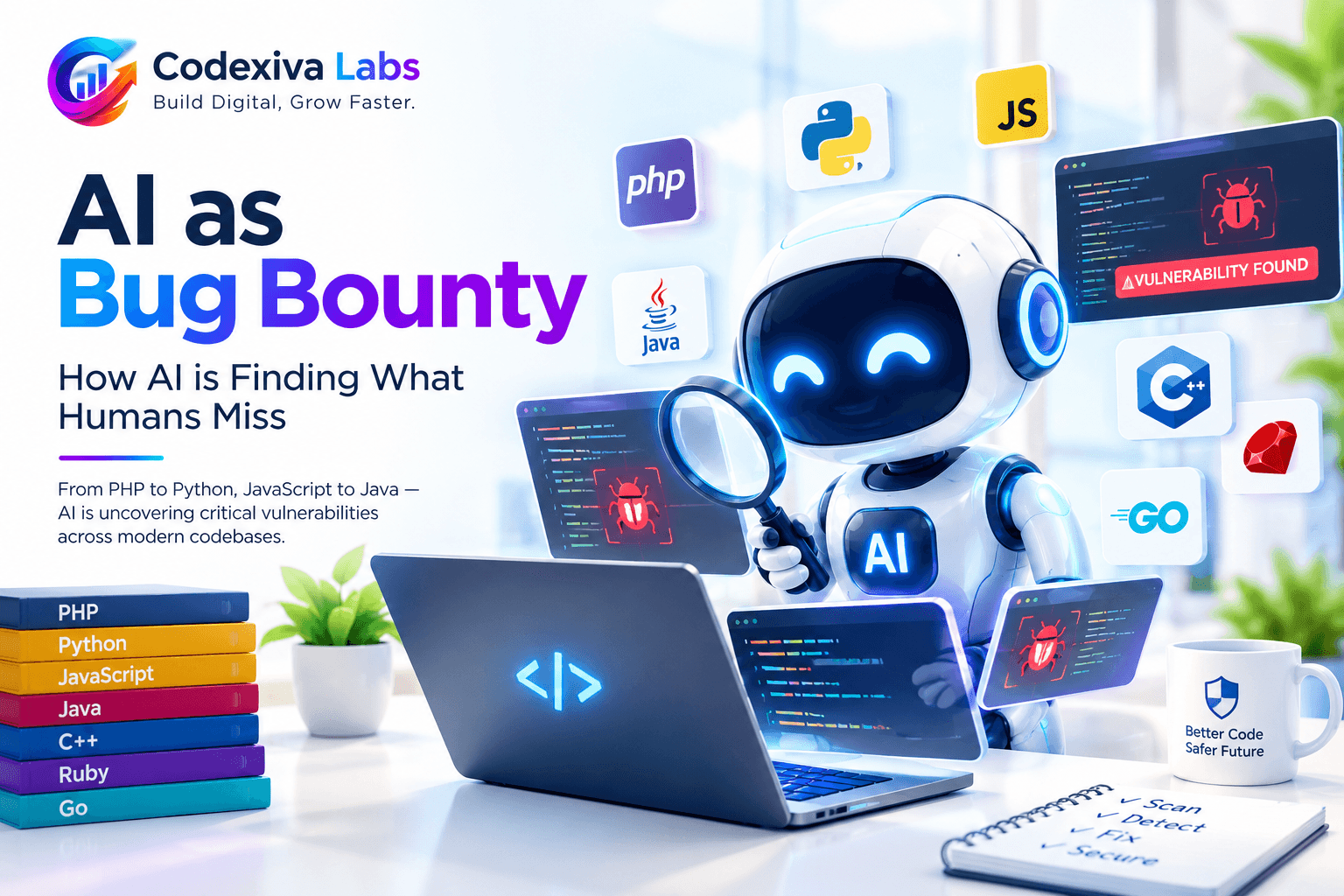
AI-Powered Bug Bounty Hunting: How Artificial Intelligence Is Finding Security Vulnerabilities in PHP, Python, JavaScript, and More
Artificial intelligence is changing how developers build software—and how security researchers find vulnerabilities in it. Tasks that once required hours of manual code review can now be assisted by AI systems capable of analyzing code, tracing data flows, identifying suspicious patterns, and helping researchers investigate potential security weaknesses.
From PHP web applications to Python APIs, JavaScript frontends, Java enterprise systems, and C++ applications, AI is becoming a powerful assistant in modern bug bounty hunting.
But can AI really find security bugs that human researchers miss? And what happens when AI discovers vulnerabilities faster than organizations can fix them?
Let's explore the technology, real-world developments, programming languages, and security challenges behind AI-powered bug bounty hunting.
What Is AI-Powered Bug Bounty Hunting?
Bug bounty hunting is the process of identifying and responsibly reporting security vulnerabilities in software, websites, APIs, and other digital systems. Organizations often reward researchers for discovering valid vulnerabilities within authorized testing programs.
AI-powered bug bounty hunting uses artificial intelligence to support this process through capabilities such as:
- Intelligent code analysis: Identifying suspicious code patterns and potentially unsafe functions.
- Automated vulnerability discovery: Finding possible injection flaws, authentication weaknesses, and insecure data handling.
- Code reasoning: Following how untrusted input moves through an application and checking whether it reaches sensitive operations.
- Exploit validation assistance: Helping researchers determine whether a suspected issue is genuinely exploitable.
- Patch recommendations: Suggesting safer implementations and fixes for confirmed vulnerabilities.
- Security report generation: Organizing evidence, explaining impact, and preparing remediation guidance.
AI does not automatically make every finding correct. Human validation remains essential because generated findings can include false positives, incomplete reasoning, and incorrect assumptions about an application's environment.
Why AI Is Changing Cybersecurity
Traditional vulnerability discovery often combines manual code review, static analysis, dynamic testing, and penetration testing. Each method has strengths, but complex applications can contain millions of lines of code, interconnected services, and subtle security assumptions.
AI can help researchers prioritize suspicious areas, understand unfamiliar codebases, and connect weaknesses across different components.
The most important advantage is not simply speed. It is the ability to combine code understanding with existing security tools and repeat investigative tasks consistently.
However, AI-generated results must be tested against actual program behavior. A plausible explanation is not proof of a vulnerability.
Real-World Examples: AI Finding Security Vulnerabilities
AI security research is moving beyond theoretical demonstrations. Several developments show how AI systems can help uncover bugs in real software.
1. Anthropic's Claude and Vulnerability Research
Anthropic has published research on using its Claude models for cybersecurity tasks, including code analysis and vulnerability discovery. Its Claude Mythos Preview announcement in 2026 also brought attention to advanced AI capabilities for identifying and analyzing software vulnerabilities.
These developments highlight the potential for AI systems to identify complex security weaknesses in large codebases. They also reinforce the need for controlled testing, responsible disclosure, and strong safeguards around powerful cyber capabilities.
The important lesson is that AI can assist with sophisticated security research, but individual findings still require technical verification and responsible handling.
2. Google's Big Sleep AI Security Research
Google's Big Sleep project demonstrated the potential of AI-assisted vulnerability research by identifying previously unknown security issues in real-world software.
The project illustrates how AI agents can help investigate code, develop hypotheses about potential weaknesses, and support the process of finding bugs that conventional approaches may overlook.
This does not mean AI can find every vulnerability. Instead, it shows how combining AI reasoning with security expertise can expand the scope of software testing.
3. AI-Assisted Discovery in Open-Source Software
AI-assisted security workflows can analyze open-source repositories to flag potentially unsafe operations, trace untrusted input, and suggest test cases for suspicious code paths.
For example, an AI assistant reviewing a web application might identify a database query that appears to combine user input with SQL statements. A researcher can then inspect the surrounding code, reproduce the behavior in an authorized environment, and determine whether the application is actually vulnerable.
These examples demonstrate a broader trend: AI is increasingly useful as a security research assistant rather than a replacement for verification and engineering judgment.
AI and PHP Security: Finding Vulnerabilities in Web Applications
PHP remains widely used for websites, APIs, content management systems, and e-commerce applications. Its flexibility also means developers must carefully handle user input, authentication, authorization, and database access.
AI-assisted code review can help identify potential issues such as:
- SQL injection: Unsafe construction of database queries.
- Cross-site scripting (XSS): Output that is not correctly escaped for its context.
- Broken access control: Missing authorization checks around sensitive operations.
- Insecure file uploads: Weak validation of uploaded files and their storage locations.
- Path traversal: User-controlled file paths that may access unintended files.
- Session weaknesses: Insecure session handling or authentication logic.
- Unsafe deserialization: Processing untrusted serialized data in dangerous ways.
For example, an AI code reviewer may flag a PHP endpoint that accepts a record ID from a request but does not appear to verify whether the authenticated user is authorized to access that record.
The key question is not merely whether the code contains a suspicious pattern. It is whether the application enforces authorization correctly across the complete request flow.
PHP security best practice: Use parameterized database queries, context-aware output escaping, strict authorization checks, secure session configuration, and maintained dependencies.
Python: AI-Assisted Security for APIs and Backend Services
Python powers many web APIs, automation systems, data platforms, and AI applications. Frameworks such as Django, Flask, and FastAPI provide useful security features, but developers must configure and use them correctly.
AI-assisted vulnerability analysis can help investigate:
- Broken authentication and authorization.
- Server-side request forgery (SSRF).
- Unsafe deserialization and untrusted data processing.
- Command injection.
- Insecure API endpoints.
- Hardcoded credentials and exposed secrets.
- Dependency vulnerabilities.
- Misconfigured security settings.
An AI tool reviewing a Python API might identify a request handler that accepts a URL and passes it to a server-side HTTP client without sufficient destination validation. A researcher can then assess whether the behavior permits unauthorized access to internal resources.
The finding must be evaluated in context because network restrictions, URL validation, and other controls may prevent exploitation.
Python security best practice: Validate untrusted inputs, enforce authorization at the server, restrict outbound requests, avoid unsafe deserialization, and scan dependencies for known vulnerabilities.
JavaScript and TypeScript: Finding Client-Side and Server-Side Bugs
JavaScript applications introduce security challenges across browsers, servers, and third-party integrations. TypeScript can improve code clarity and type safety, but types alone do not validate untrusted runtime input.
AI-assisted security tools can help review:
- Cross-site scripting and unsafe DOM manipulation.
- Server-side request forgery in Node.js applications.
- Broken access control in APIs.
- Insecure authentication and session management.
- Prototype pollution.
- Exposed API keys and secrets.
- Vulnerable npm dependencies.
- Unsafe handling of user-controlled redirects.
For example, an AI assistant might flag code that inserts user-controlled content into an HTML page using an unsafe DOM API. The researcher can inspect the data flow and verify whether an attacker could control the inserted content.
JavaScript security best practice: Use safe DOM APIs, validate input at trust boundaries, protect credentials, apply appropriate content security policies, and keep dependencies updated.
Java, C++, Go, and Other Languages
AI-assisted vulnerability discovery is not limited to web development.
Java
AI can assist in reviewing Spring applications, authentication flows, deserialization logic, database access, and authorization rules. It can also help investigate dependency vulnerabilities and insecure configurations.
C and C++
Memory safety remains a major challenge in low-level software. AI can help analyze code involving buffer boundaries, memory allocation, pointer usage, and unsafe input processing. Findings should be confirmed through testing, sanitizers, static analysis, and careful review.
Go
AI can assist with reviewing HTTP handlers, authorization middleware, concurrency, input validation, and network-facing services. Developers should pay particular attention to access controls and unsafe assumptions about request data.
Ruby and Rust
For Ruby applications, AI can help identify unsafe input handling, authorization problems, and dependency risks. For Rust, it can help review application logic, unsafe blocks, and security-sensitive interfaces, although Rust's memory-safety guarantees do not eliminate every class of vulnerability.
Across all these languages, the most valuable results come from combining AI reasoning with established testing and analysis tools.
How an AI Bug Bounty Workflow Works
A responsible AI-assisted security workflow can be organized into seven stages:
- Define authorization: Identify the exact repositories, applications, APIs, and environments that are approved for testing.
- Map the attack surface: Understand exposed endpoints, dependencies, authentication boundaries, and sensitive data flows.
- Analyze the code: Use AI-assisted review and static analysis to identify potentially risky code paths.
- Prioritize findings: Rank issues according to potential impact, exploitability, and available evidence.
- Validate safely: Reproduce suspected vulnerabilities in a controlled environment without accessing unauthorized data or disrupting services.
- Report responsibly: Document the affected component, evidence, impact, and recommended remediation.
- Verify the fix: Retest the corrected code and check that the vulnerability has been resolved without introducing regressions.
This workflow helps transform AI-generated suspicions into actionable security findings.
Can AI Replace Human Bug Bounty Hunters?
Not completely.
AI can analyze code quickly, summarize unfamiliar systems, generate test ideas, and help connect information across a large repository. However, successful vulnerability research requires context that may be missing from source code alone.
Human researchers remain important for:
- Understanding business logic and security boundaries.
- Distinguishing genuine vulnerabilities from harmless patterns.
- Confirming exploitability and real-world impact.
- Avoiding unsafe or unauthorized testing.
- Communicating findings clearly to developers.
- Making informed decisions about responsible disclosure.
The strongest approach combines AI assistance with human expertise, automated security tools, and reproducible evidence.
Limitations and Risks of AI Security Tools
AI-powered vulnerability discovery also introduces important challenges.
False positives: A tool may identify a risky-looking code pattern that is protected by another control.
False negatives: AI may overlook subtle vulnerabilities, especially those involving complex state, concurrency, or interactions between services.
Incomplete context: A model may not have access to deployment settings, runtime behavior, or every relevant dependency.
Confidentiality risks: Sending proprietary source code or credentials to an external AI service may expose sensitive information if the service and its configuration are not appropriate for that data.
Unsafe automation: Automatically testing every generated hypothesis can disrupt systems or exceed a bug bounty program's rules.
Organizations should use approved environments, protect sensitive information, restrict automated testing, and require verification before treating an AI-generated finding as a confirmed vulnerability.
The Future of AI-Powered Bug Bounty Hunting
AI is likely to become a standard component of software security workflows. As models improve at understanding codebases and using testing tools, researchers may be able to investigate more complex vulnerability chains and assess larger applications more efficiently.
The next stage is not simply generating more vulnerability reports. It is producing fewer false positives, stronger evidence, safer validation, and faster remediation.
For software teams, this means integrating AI-assisted security review into development without abandoning established practices such as code review, dependency scanning, penetration testing, and secure software design.
For bug bounty researchers, it means learning how to direct AI tools, validate their findings, and communicate real security impact.
Conclusion
AI is changing the way security researchers discover and investigate software vulnerabilities. From PHP and Python to JavaScript, Java, C++, and Go, AI-assisted analysis can help identify suspicious code, prioritize risks, and accelerate security testing.
Real-world research from organizations such as Anthropic and Google demonstrates the growing potential of AI in vulnerability discovery. But AI-generated findings are only the beginning: responsible testing, human verification, and timely remediation remain essential.
At Codexiva Labs, we believe building better digital products means making security part of the development process. AI can help teams move faster—but secure engineering is what turns that speed into lasting value.
Build Digital, Grow Faster.
Frequently Asked Questions
What is AI-powered bug bounty hunting?
It is the use of AI to assist security researchers in identifying, analyzing, and validating vulnerabilities in software and digital systems.
Can AI find vulnerabilities in PHP applications?
Yes. AI-assisted tools can help identify potential SQL injection, XSS, access-control issues, insecure file handling, and other weaknesses. Each finding must be validated in context.
Which programming languages can AI security tools analyze?
Depending on the tool, supported languages may include PHP, Python, JavaScript, TypeScript, Java, C, C++, Go, Ruby, and Rust.
Is an AI-generated vulnerability report always accurate?
No. Reports can contain false positives, miss important context, or describe issues that cannot be reproduced. Independent validation is necessary.
Can developers use AI to secure their applications?
Yes. Developers can use AI to review code, explain security risks, generate tests, suggest fixes, and support secure code reviews. AI should complement—not replace—established security practices.